
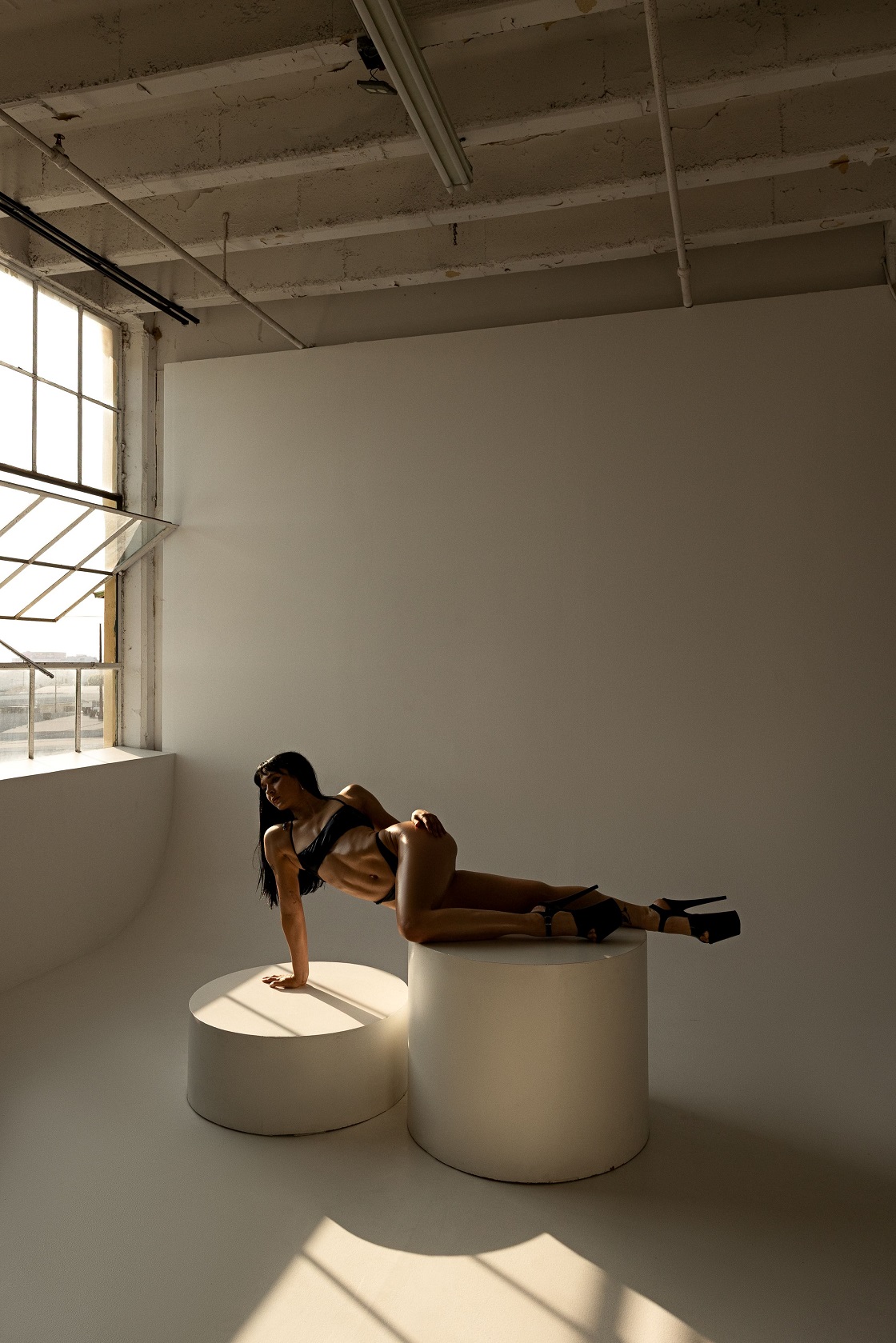
In contemporary interiors, art is no longer an afterthought. It doesn’t simply decorate a space — it defines its rhythm, its tension, and often its emotional atmosphere. Among artists working at the intersection of form, body, and space, Valeriia Guznenkova occupies a distinct position.
A fine art photographer and the creator of the Guznenkova Method, she approaches the female body not as an image to be displayed, but as a structural form that interacts with light, surface, and environment. Her works are minimal, controlled, and visually restrained — qualities that allow them to exist in interiors not as accents, but as spatial elements.
We spoke with Valeriia about how her images function within space, how to choose art for an interior, and why a photograph can influence not only how a room looks, but how it feels.
Olivia: Valeriia, your works often feel more like objects than images. How do you see their role within an interior?
Valeriia: I don’t think of my work as something that decorates a space. For me, it either becomes part of the structure of the interior or it doesn’t belong there at all. When an image is built around form, it starts to behave differently — it doesn’t just sit on the wall, it interacts with the space, with light, with movement. It creates a certain presence, and that presence is what defines its role.
Olivia: What determines whether a work integrates well into a space?
Valeriia: Clarity. If an image is overloaded — visually or emotionally — it becomes difficult to place. It starts competing with the space instead of working with it. I try to reduce the image to what is essential: body, light, space, structure. This simplicity allows the work to exist in different environments without losing its integrity.
Olivia: There is a noticeable sense of restraint in your work. Why is that important for interiors?
Valeriia: Because interiors are something you live with every day. An image that is too expressive or too direct can become exhausting over time — it demands constant attention. Restraint creates longevity. The image doesn’t reveal everything immediately, it allows perception to unfold gradually, and that makes it possible to live with it without losing interest.
Olivia: Your subjects often don’t look at the viewer and don’t engage directly. How does that affect the way the work exists in a space?
Valeriia: It removes the pressure of interaction. The image doesn’t demand attention in an obvious way and doesn’t try to hold the viewer. Because of that, it becomes more stable and less dependent on reaction. It simply exists in the space, and that makes it more sustainable over time.
Olivia: You often speak about the body as form. How does this idea translate into interior aesthetics?
Valeriia: When the body is approached as form, it becomes closer to sculpture or architecture. It stops being tied to a specific story or identity and starts functioning through proportion, balance, and structure. That’s why it integrates into interiors naturally — it doesn’t illustrate something, it becomes part of the spatial composition.
Olivia: What is the most common mistake people make when choosing art for their interiors?
Valeriia: Trying to match everything. Matching colors, shapes, or style usually leads to predictable and flat results. A strong artwork doesn’t repeat the space — it adds something to it. It can create contrast, tension, or balance, but it should always bring something new rather than simply fit in.
Olivia: Can a photograph actually change how we experience a space?
Valeriia: Absolutely. We often think about interiors in terms of physical objects, but perception plays an equally important role. A single image can shift how a space feels — it can make it calmer, sharper, or more grounded. And often, this happens without people even realizing it.
Olivia: What does it mean for you to see your work inside someone’s home rather than in a gallery?
Valeriia: In a gallery, the work exists in a neutral environment. In a home, it becomes part of someone’s life. It interacts with daily routines, personal habits, and the emotional atmosphere of the space. That changes the way the work exists — it becomes more real.
What becomes clear in speaking with Valeriia Guznenkova is that her work resists being reduced to either photography or decoration. It occupies a more complex position — somewhere between image and object, between visual form and spatial element.
Her approach challenges a common assumption in interior design: that art must adapt to space. Instead, her work suggests that a carefully constructed image has the ability to shape and redefine the space around it.
In this sense, Guznenkova’s photographs are not additions to an interior. They are part of its structure — quiet, precise, and enduring.
Interview by Olivia Carter
March 30, 2026
Website: https://byguznenkova.com/
